SpringOne 2GX 2011
Chicago, October 25-28, 2011

For Members

 Magnificent Mile Marriott
Downtown Chicago
540 North Michigan Ave.
Chicago, Illinois 60611
1 (800) 228-9290
[ Map it ]
Tim Berglund
Developer, Consultant, Author


Tim is a full-stack generalist and passionate teacher who loves coding, presenting, and working with people. He believes the best developer is one who is well-informed of specifics and can also make deep connections between software development and the broader world. He has recently been exploring non-relational data stores, continuous deployment, and how software architecture should resemble an ant colony.
His firm, the August Technology Group, helps clients with product development, technology consulting, and technology upgrade projects atop the JVM. The August Group's technology preferences reflect the generalist sensibilities of its founder, and its development practices are always lightweight, self-improving, and humanizing by design.
Tim is a speaker internationally and on the No Fluff Just Stuff tour in the United States, and is co-president of the Denver Open Source User Group in the Denver area, co-author of the DZone Clojure RefCard, co-presenter of the best-selling O'Reilly Git Master Class, co-author of Building and Testing with Gradle, and a member of the O'Reilly Expert Network.
He lives in Littleton, CO with the wife of his youth and their three children.
His firm, the August Technology Group, helps clients with product development, technology consulting, and technology upgrade projects atop the JVM. The August Group's technology preferences reflect the generalist sensibilities of its founder, and its development practices are always lightweight, self-improving, and humanizing by design.
Tim is a speaker internationally and on the No Fluff Just Stuff tour in the United States, and is co-president of the Denver Open Source User Group in the Denver area, co-author of the DZone Clojure RefCard, co-presenter of the best-selling O'Reilly Git Master Class, co-author of Building and Testing with Gradle, and a member of the O'Reilly Expert Network.
He lives in Littleton, CO with the wife of his youth and their three children.
Presentations
Plugging Into Gradle Plugins
Gradle is being adopted by enterprises and open-source projects alike for its ease of use, flexibility, and compatibility with existing standards. However, Gradle's true strength shines not when it is viewed as a wrapper around standards, but as a toolkit for creating your own standards to reflect your build patterns and practices. It is extensible at every level, but most powerfully at the level of Gradle plugins.
In this session, you'll learn the Gradle APIs you need to know to develop a plugin, the different ways to organize and distribute plugins, and the way you should use plugins as a means of extending the Gradle DSL to describe your build domain in a concise and idiomatic way. Examples will use real code for a plugin written by Tim and Matthew that can be used in development and automated deployment settings.
Grails in Front, Cassandra In Back
Cassandra is a scalable, highly available, column-oriented data store in use at Facebook, Netflix, Twitter, Reddit, Rackspace, and a growing list of other deployments. It offers a compelling combination of a rich data model, a robust deployment track record, and a sound architecture—and it isn't just for web-scale operations. It might be a good fit for your Grails app!
In this session, we'll learn the basics of Cassandra, then look at how to use it for storing data in a simple Grails application. We'll work through a simple data modeling exercise and look at the code required for interfacing with this leading NoSQL solution.
Books
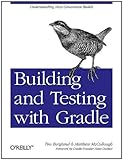
by Tim Berglund and Matthew McCullough
 Price: $24.99
-
Build and test software written in Java and many other languages with Gradle, the open source project automation tool that’s getting a lot of attention. This concise introduction provides numerous code examples to help you explore Gradle, both as a build tool and as a complete solution for automating the compilation, test, and release process of simple and enterprise-level applications.
Discover how Gradle improves on the best ideas of Ant, Maven, and other build tools, with standards for developers who want them and lots of flexibility for those who prefer less structure.
- Use Gradle with Groovy, Clojure, Scala, and languages beyond the JVM, such as Flex and C
- Get started building a simple Java program using Gradle's command line tooling and a small build script
- Learn how to configure and construct tasks, Gradle's fundamental unit of build activity
- Take advantage of Gradle's integration with Ant
- Use Gradle to integrate with or transition from Maven, and to build software more cleanly
- Perform application unit and integration tests using JUnit, TestNG, Spock, and Geb
Price: $24.99
-
Build and test software written in Java and many other languages with Gradle, the open source project automation tool that’s getting a lot of attention. This concise introduction provides numerous code examples to help you explore Gradle, both as a build tool and as a complete solution for automating the compilation, test, and release process of simple and enterprise-level applications.
Discover how Gradle improves on the best ideas of Ant, Maven, and other build tools, with standards for developers who want them and lots of flexibility for those who prefer less structure.
- Use Gradle with Groovy, Clojure, Scala, and languages beyond the JVM, such as Flex and C
- Get started building a simple Java program using Gradle's command line tooling and a small build script
- Learn how to configure and construct tasks, Gradle's fundamental unit of build activity
- Take advantage of Gradle's integration with Ant
- Use Gradle to integrate with or transition from Maven, and to build software more cleanly
- Perform application unit and integration tests using JUnit, TestNG, Spock, and Geb
- NFJS SITES:
- No Fluff Just Stuff
- Uber Conf
- NFJS One
- SpringOne 2GX
- Rich Web Experience
- Project Automation Experience
- SPRINGSOURCE SITES:
- Springsource.com
- Springsource.org
© 2011 No Fluff, Just Stuff TM and SpringSource, a division of VMware. All rights reserved. Java is a registered trademark of Oracle.